Merricks Capital provides innovative investment solutions that deliver consistent performance for its investors while operating with financial discipline and prudent risk.
Our investment strategies include private credit across commercial real estate, agriculture and infrastructure and specialised industrial.
Established in 2007, Merricks Capital delivers a truly differentiated multi-strategy offering, with extensive investment capability and global experience spanning multiple asset classes.
Cycle Turning, Capital Returning: The NZ Easing Window
Share
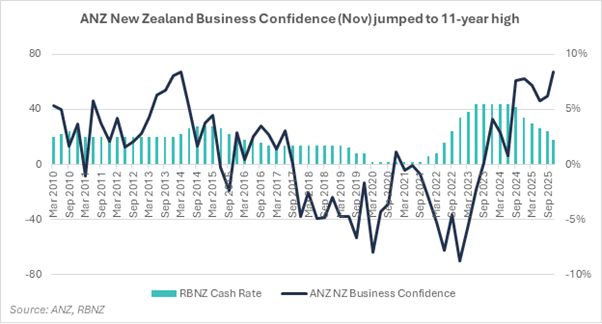
The past month has delivered several signals that New Zealand is entering an early-stage recovery phase, including another 25bps cut to 2.25% by the RBNZ last week and the full repayment of the Hotel Indigo, Albert Street development facility from our loan portfolios. This $150m NZD loan, originated in 2021 to fund a 225-room hotel and 30 luxury residences, navigated COVID-era disruption, construction volatility and the steepest tightening cycle in two decades, now repaying as rates fall and liquidity improves. This combination of easing policy, clearer refinancing pathways and stabilising construction dynamics is translating into private credit opportunity across the Tasman. This is in stark contrast to Australia which is still battling inflation and more competition in private credit.
Key Insights
Rate cuts and bank lending margin compression have had a meaningful effect on borrower serviceability. Fifteen months after the first rate move, a total of 325bps of cumulative RBNZ easing, while current macroeconomic conditions remain supportive of a credible path for NZ rates to move further toward a 1-handle.
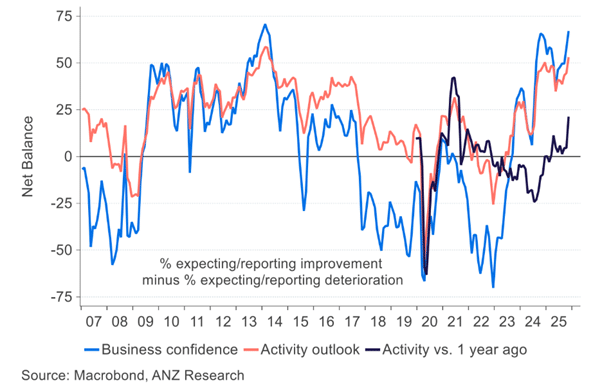
Residential leading indicators are turning up, and we are seeing this across our NZ loan portfolio, which includes $250m of residential exposure. National house prices have risen ~3–4% over the past six months (REINZ HPI), pre-sales on development projects have been strong during Q4 2025, and institutional purchasers are competing to secure retirement-living assets, all activity that points to a clear uplift in confidence and forward demand.
While the regional economies are buoyed by strong export receipts, GDP growth remain subdued with migration now firmly below post-COVID peaks and labour continuing to flow to higher-wage opportunities in Australia. Further disinflation and a lower policy-rate trajectory over the next 12–18 months remain our base case assumptions.
The result is our expectation of strengthening interest cover and improving liquidity in the local investment market as yield spreads decompress and positive leverage returns to most asset classes. In comparison, private-credit margins remain wide, enhancing real-return premium.
Supply constraints are supporting values for completed commercial real estate. Non-residential consents are growing at just 0.8% annually and construction volumes are down 1.8% q/q (Stats NZ), meaning fewer competing projects will deliver into a falling-rate environment while underlying space demand remains resilient.
The office market remains bifurcated, favouring prime assets. Auckland CBD prime vacancy is now below 9% (down from ~12% at the start of the year)(JLL), while secondary vacancy remains elevated at 18–20% (Colliers, JLL), reinforcing the value of lending to modern, well-located assets at conservative leverage.
This environment strengthens our conviction in New Zealand senior-secured private-credit opportunities at this stage of the cycle. Valuations have reset to more sustainable levels against a backdrop of improving investment market liquidity, delivery risk has moderated as construction costs stabilise, and the forward supply pipeline remains thin after several years of under-investment. Together, these factors create one of the most attractive windows in recent years to provide structured, asset-backed capital to high-quality NZ borrowers.