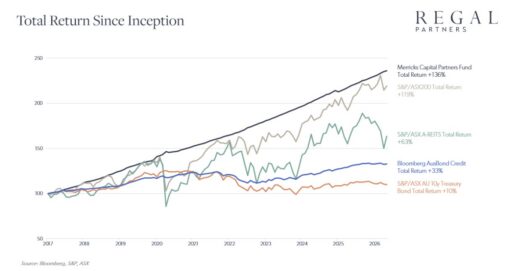
Increasingly, we are seeing both macro and local signals that private credit markets are entering a constructive phase for new deployment as risk premia rise. Borrowers are prioritising certainty of capital, banks remain selective, and new loans are being written with stronger pricing, tighter structures and more conservative assumptions. Key insights on the current opportunity set:
- Nervous bond markets are once again reinforcing the value of shorter-duration credit. The recent sell-off in long-dated sovereign bonds, US 30-year Treasury and Australian 10-year yields around 5%, reflect rising term premia for inflation, fiscal and policy uncertainty. For private credit, this supports floating-rate, shorter-duration loans driven more by asset-level cashflows, collateral and repayment pathways than rate forecasting.
- Portfolio repayments are creating the capacity to rotate into a stronger vintage. Q1 loan-level repayments increased to $235m, compared with $50m in the prior year. This matters because capital is being recycled from older loans into new facilities with more attractive through-the-cycle premia and at today’s valuations which reflect the impact of higher real rates on long duration assets.
- Global institutional capital remains highly liquid but selective, while Australia and New Zealand are behind the curve on productivity and growth. After dozens of meetings across North Asia and the US, we observed constructive demand for income-oriented private markets. Domestically, broader adoption of new technology and more business-friendly policy settings is likely to be a 2027 story. On a probability-weighted basis, this suggests inflation fears and macro pessimism may peak in coming months, supporting our tilt toward floating-rate opportunities while creating scope to selectively add longer-duration assets and cashflows where easing inflation concerns can shift from headwind to tailwind.
- New deployment is increasing exposure to sectors with stronger inflation linkage. Agriculture, precious metals and infrastructure are becoming a larger part of the opportunity set, while office exposure has declined to below 20%. We continue to see attractive deployment opportunities, with new loan settlements of more than $650m over the past two months at a weighted average investor IRR of 13% across a more diversified sector pool. Spreads remain 100–150bps wider than 3–6 months ago for comparable or better risk.
- Generally, our portfolios are performing well, with the construction delays experienced through 2020-24 now largely behind us. Rising replacement values for built-form assets are increasing the future moat for borrowers with complete income-producing assets. The main area of concern remains redevelopment assets, where the step-up in construction costs continues to weigh on project feasibilities.
The message for investors is that the private credit opportunity is shifting, not fading. Recent portfolio activity shows that capital remains available for quality real assets, particularly where projects have credible sponsors, clear collateral value and identifiable takeout options. With public markets volatile, bond yields unsettled and banks still cautious, senior secured real asset credit remains well placed to deliver contractual income and shorter-duration exposure.
As we approach the 10-year anniversary of the Merricks Capital Partners Fund, the Fund’s history supports the thesis that private credit can generate equity-like returns with lower volatility than listed markets. However, as we reiterate in almost every investor discussion, these returns still require disciplined risk-taking and the ability for clients to capture an illiquidity premium through non-traded investments.