June 5, 2026
Infrastructure: Real Assets for an Uncertain Inflation Cycle
Share
With bond markets this week still debating the path for rates in Australia, investors should be looking beyond headline yield and focused on the durability of income. Infrastructure and specialised industrial assets are attractive in this context because their value is often anchored by essential use, high replacement cost and recurring demand. For the Merricks Capital Partners Fund, these investments now represent approximately 15% of the portfolio across port infrastructure and industrial food processing assets.
- Our house view is that cost pressures are likely to remain higher for longer, but the duration of that pressure is uncertain. Geopolitics and government spending continue to drive inflationary pressure, making inflation-linked protection important in the near term, whether this period proves to be 3 months or 3 years.
- We actually see a number of scenarios where inflation corrects faster than the market expects, as AI-led deflation and a weaker economy force rate cuts, at which point duration becomes increasingly valuable. Real assets with inflation linkage remain a defensive way to play this cycle, with protected downside and the ability to earn a 10% IRR.
- Infrastructure and specialised industrial assets provide a genuine diversifier to real estate credit. The lending thesis is grounded in real-world utility: assets that move freight, process agricultural output, support regional industry and provide essential operating capacity. In many cases, value is driven less by cap-rate compression or improving transaction markets, and more by scarcity, replacement cost, and recurring demand.
- The best opportunities are often in the mid-market ($50m-$300m). Ports, processing assets, logistics infrastructure and operational industrial facilities can be too small or bespoke for large infrastructure funds, while also sitting outside standard bank credit appetite. This creates an opportunity for senior secured lenders that can assess collateral, cashflow and repayment pathways asset by asset.
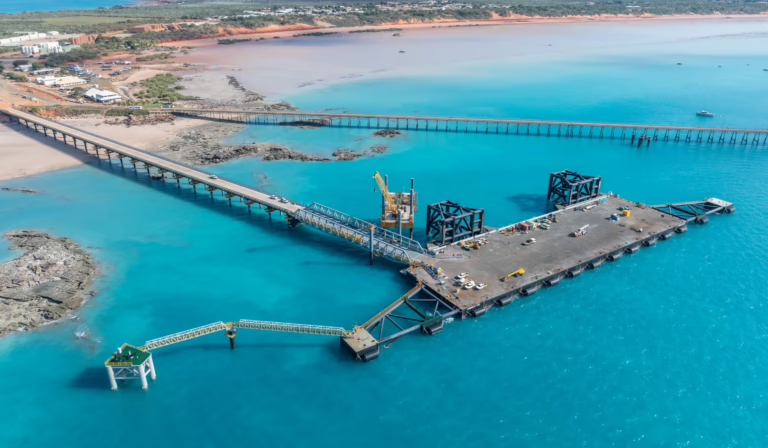
- Ports are a clear example of the thesis. Australia’s ports handle approximately 99% of import and export trade volumes and underpin around $650 billion of annual commerce (Ports Australia), while new capacity is constrained by approvals, location scarcity and high replacement cost. The Fund’s exposure to T-Ports and Kimberley Marine Support Base reflects this dynamic: essential regional infrastructure, strong asset backing and demand linked to trade, agriculture, resources and supply-chain resilience.
The new vintage for private credit continues to strengthen. Across our funds, recent deployment is increasing exposure to sectors with strong asset backing, inflation linkage and structural demand, including agriculture, infrastructure and resources, while office exposure has declined to below 20%. New loan settlements of more than $500 million over the past two months demonstrate clear momentum, with capital being recycled into wider spreads and tighter structures than was available 3–6 months ago. For investors, this is the benefit of a short-duration, actively managed private credit portfolio: capital is progressively rotating out of older exposures and into a more attractive new vintage.